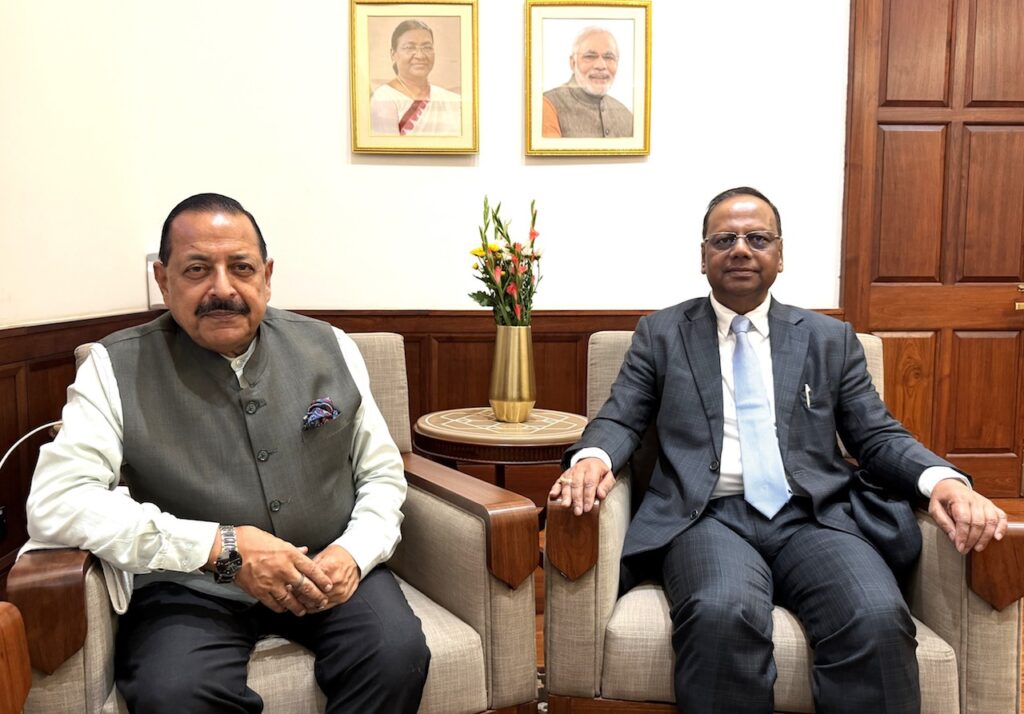

Justice Ranjit Vasantrao More, the Chairman of the Central Administrative Tribunal (CAT), recently met Union Minister Dr. Jitendra Singh to discuss the Tribunal’s initiatives aimed at enhancing administrative justice across India. This meeting took place in New Delhi and highlighted the importance of governance reforms under Prime Minister Narendra Modi’s leadership.
During the meeting, Justice More conveyed significant statistics: since its establishment, CAT has received over 10 lakh cases, efficiently disposing of more than 9.32 lakh cases. This impressive figure contributes to an overall case disposal rate exceeding 93 percent.
Dr. Jitendra Singh emphasized that improving public institutions requires continuous reforms, making administrative justice crucial in promoting good governance. He stated, “Administrative justice is an integral component of good governance, which must consistently evolve to enhance accessibility and efficiency for government employees nationwide.”
The Minister pointed out that technology drives many of these reforms. Digital platforms enable institutions to deliver services promptly, enhance accountability, and reduce procedural delays, resulting in a more citizen-responsive governance system.
Notably, Dr. Singh acknowledged CAT’s progress in digital transformation, revealing that the Tribunal’s expanding digital ecosystem, along with improved infrastructure, bolstered its case disposal capabilities. He stated, “These initiatives contribute towards a more efficient and accessible administrative justice delivery system.”
Access to justice remained a key focus for Dr. Singh. He highlighted the establishment of new Benches and Circuit Sittings in remote areas, which have made administrative justice more accessible to litigants, cutting down travel time and costs for government employees serving in diverse locations.
Justice More reiterated the importance of institutional reforms in achieving measurable outcomes. He remarked, “The consistent improvement in case disposal rates, alongside modernizing judicial processes, underscores the value of sustained reforms enhanced by technology and efficient administrative systems.”
Justice More informed the Minister about several significant initiatives introduced by CAT in recent years. This includes the establishment of new Benches at Jammu and Srinagar and Circuit Sittings at Puducherry, Leh, Kargil, and Vijayawada, thereby broadening access to administrative justice for citizens in underserved regions.
The Chairman also elaborated on the advancements made under the Advanced Case Information System (ACIS), which facilitates a spectrum of digital services. These services include e-filing, virtual hearings, online display boards, and SMS and email alerts, further ensuring seamless communication between the Tribunal and the public.
Dr. Singh stated that such initiatives are closely aligned with the Government’s vision of Digital India, where technology promotes transparency and efficiency. He noted, “Digital transformation is creating institutions that are not only accessible but also responsive and future-ready.”
During the briefing, Justice More reiterated the Tribunal’s achievements since its inception, citing a significant reduction in case pendency despite the continuous influx of new cases. He revealed that the annual disposal in recent years has consistently outpaced fresh submissions.
Additionally, the Chairman discussed the implementation of e-Office across all Benches, integration of officers into e-HRMS, and the adoption of the Public Financial Management System (PFMS). Notably, digital processing of pension cases through the Bhavishya Portal exemplifies the Tribunal’s commitment to modern governance practices.
Dr. Jitendra Singh asserted that the Government will continue to back reforms aiming to reinforce institutional capacity and improve public service delivery. He affirmed, “Our objective is to ensure governance reforms translate into concrete benefits for employees and citizens alike, fostering an accountable and efficient administrative system.”