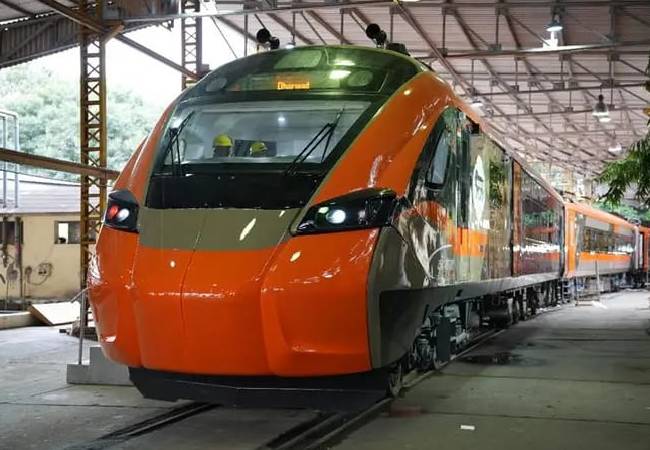

Railway Minister Ashwini Vaishnaw announced on Tuesday that the much-anticipated Vande Bharat Sleeper trains will launch once the second train is ready for regular service, expected by October 15, 2025. This awaited advancement in Indian rail travel aims to enhance long-distance connectivity.
Currently, one train has completed all necessary trials at the Shakur Basti Coaching Depot in Delhi, demonstrating the Indian Railways’ commitment to improving passenger services. Vaishnaw emphasized the significance of both trains commencing service together to ensure reliable travel.
“Both the trains will be launched together,” he confirmed, highlighting the second train’s importance in maintaining continuity in operations. The strategic decision aims to avoid stretches of service interruptions and ensure that passengers can rely on consistent travel options.
Speculation about potential routes has suggested a strong possibility of launching services between New Delhi and Patna, particularly as Bihar gears up for pivotal elections by year-end. This route could significantly benefit commuters traveling for work and families visiting for the polls.
In a related briefing, Minister of State for Railways Ravneet Singh Bittu joined Vaishnaw to discuss significant railway projects underway in Punjab. The upcoming Rajpura-Mohali line, spanning 18 kilometers, promises direct connectivity to Chandigarh, reducing travel by approximately 66 kilometers.
This new rail link not only aims to ease traffic congestion on existing routes but also enhances accessibility, thereby supporting local economies. The project’s aim is to forge closer links among communities and economic hubs, making travel not just faster but also more efficient.
Furthermore, the Railway Ministry proposed a new Vande Bharat train service between New Delhi and Firozpur Cantonment. This service will cover multiple important stations, including Faridkot, Bhatinda (W), and Patiala, over a distance of 486 kilometers in 6 hours and 40 minutes.
Vaishnaw articulated the ministry’s intention by stating, “I will request the Prime Minister to approve the Firozpur-Delhi Vande Bharat train,” signifying the government’s proactive approach to enhancing national rail connectivity.
The ministers outlined a list of nine crucial railway projects commissioned since 2014, reflecting substantial investments in Indian infrastructure. These projects include the new Nangal Dam-Daulat Pur Chowk line and the ambitious doubling of the Chakki Bank-Bharoli line.
In addition to these initiatives, seven other notable railway projects are under execution, such as the Nangal Dam-Talwara new line and the doubling of the Mansa-Bhatinda line, further emphasizing the Indian Railways’ commitment to modern infrastructure and increased capacity.
Speaking about current improvements in railway services, Vaishnaw highlighted that 30 stations are undergoing redevelopment under the Amrit Bharat station redevelopment scheme, which is expected to uplift facilities and passenger experience systematically.
In terms of operational efficiency, Vaishnaw reported impressive punctuality records across 29 rail divisions, including significant regions like Malda and Mysore, with over 90% punctuality achieved. This statistic represents a remarkable milestone in the Rail Ministry’s ongoing mission to improve travel experiences for Indian citizens.
As preparations for the Vande Bharat Sleeper train launch continue, stakeholders from various sectors remain optimistic about elevated experiences in long-distance rail travel. The upcoming months are set to be transformative for Indian Railways, reflecting a robust investment in public transport and infrastructure development.