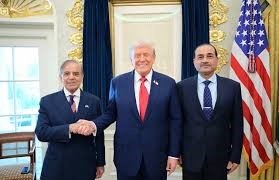

On September 26, US President Donald Trump met Pakistan’s Prime Minister Shehbaz Sharif and Field Marshal Asim Munir at the White House, addressing key elements of bilateral relations between the two nations.
This meeting marked the first formal interactions between Trump and Sharif, highlighting the ongoing importance of US-Pakistan ties nearly six years after the last engagement between Trump and former Prime Minister Imran Khan in July 2019.
Trump expressed enthusiasm for the meeting, describing Sharif as a ”great leader” while speaking to reporters after signing several executive orders. He noted the significance of having both the prime minister and the field marshal present, indicating a positive outlook for future dialogue.
The meeting occurred in the Oval Office with Vice President J. D. Vance and Secretary of State Marco Rubio in attendance. According to a statement from the Pakistan Prime Minister’s Office, the discussion occurred in a ”pleasant atmosphere” and focused on matters of mutual interest, alongside regional and global challenges.
The scheduled meeting began later than planned, starting around 5 pm local time due to Trump’s prior commitments. The closed-door discussions lasted approximately an hour and 20 minutes, during which both leaders exchanged views. Photographs shared following the meeting showed Trump smiling and giving a thumbs-up alongside Sharif and Munir.
Sharif previously met with Trump on Tuesday in New York during the UN General Assembly, where they discussed broader foreign relations, including engagements with leaders from various nations such as Egypt, Indonesia, and Saudi Arabia. This engagement was aimed at emphasizing Pakistan’s role in global dialogues, especially within the context of the UN.
Observers noted the historical context of US-Pakistan relations, marking a shift from Cold War allies to a more complex dynamic, particularly after significant political events, including the 2011 killing of Osama bin Laden in Pakistan. Such incidents have contributed to a trust deficit that has shaped present-day bilateral discussions.
Notably, the two leaders addressed ongoing economic relations, underscoring the 19% tariff recently agreed upon for Pakistani imports. According to US trade statistics, goods and services trade between the US and Pakistan reached approximately USD 10.1 billion in 2024, reflecting growth through enhanced economic collaboration.
Furthermore, US goods exports to Pakistan amounted to USD 2.1 billion, a rise of 3.3% from the previous year. Conversely, imports from Pakistan totaled USD 5.1 billion, marking an increase of 4.8%. However, the trade deficit with Pakistan saw a substantial uptick, with a reported increase of 5.9%. This growing economic engagement aims to strengthen ties despite political challenges.
Beyond trade discussions, Trump remarked on his role in navigating regional tensions in South Asia, particularly his mediation efforts during the recent India-Pakistan crisis. He indicated that this critical diplomatic involvement could warrant consideration for the 2026 Nobel Peace Prize, as proposed by Pakistani officials.
In this evolving landscape of diplomacy, both nations look towards fostering stronger ties, navigating challenges, and exploring coordinated efforts regarding regional stability and economic growth.