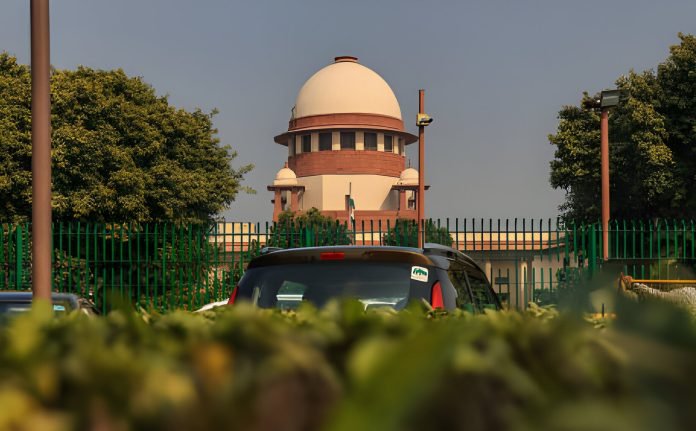

The Supreme Court of India on Wednesday took a significant step by referring the issue of whether litigants can approach high courts for anticipatory bail directly, bypassing the sessions court, to a three-judge bench. This decision has stirred discussions on the procedural aspects of bail applications across the country.
A bench led by Justices Vikram Nath and Sandeep Mehta determined that the matter necessitated larger scrutiny and should be listed before a more extensive panel once constituted. “This matter requires to be heard by a three-judge bench,” the court stated, emphasizing the importance of standardizing practices related to anticipatory bail.
The apex court had earlier appointed senior advocate Siddharth Luthra as amicus curiae to provide assistance regarding this contentious issue. The involvement of an amicus highlights the complexities and implications surrounding anticipatory bail applications.
The discussion gained momentum following the Supreme Court’s previous remarks expressing concern over the “regular practice” of the Kerala High Court entertaining anticipatory bail applications directly. On September 8, the Court questioned the rationale behind this practice, stating, “One issue that is bothering us is that in the Kerala High Court, anticipatory bail applications are regularly entertained directly. Why is that so?” This pointed inquiry reflects the Court’s concern for sustaining uniformity and adherence to established legal protocols.
While dissecting provisions under the old Code of Criminal Procedure and the newly enacted Bharatiya Nagarik Suraksha Sanhita (BNSS), 2023, the Court underscored that a clear hierarchy exists regarding bail applications. Section 482 of the BNSS specifically addresses guidelines for granting bail to individuals who fear arrest, striving to maintain a structured judicial process.
“It doesn’t happen in any other state. Only in the Kerala High Court… applications for anticipatory bail are regularly entertained directly,” noted the bench, raising alarms about potential discrepancies in judicial practices across Indian states.
The need for clarity arose during the hearing of a plea filed by two individuals appealing against a Kerala High Court order that denied them anticipatory bail. These petitioners had approached the high court directly, skipping the sessions court entirely in an attempt to secure relief.
The Supreme Court cautioned that such a practice could lead to significant gaps in factual records typically presented before a sessions court. “We are inclined to consider whether the option to approach the high court is a matter of choice for the accused or whether it should be mandatory to first go to the sessions court,” the bench remarked, highlighting concerns about procedural integrity.
Moreover, as part of its inquiries, the top court issued a notice to the Kerala High Court via its Registrar General, seeking a formal response regarding its standing practices. This step underscores the Supreme Court’s commitment to ensuring that judicial proceedings align with the principles of justice and fairness.
Experts argue that the implications of this referral could reshape the landscape of anticipatory bail applications in India. If the Supreme Court mandates a procedural hierarchy, it may significantly affect how courts across the nation handle similar cases.
As the legal community anticipates the outcome of this referral, the Supreme Court’s emphasis on regulating anticipatory bail practices reflects its broader objective of upholding justice throughout the judicial system.