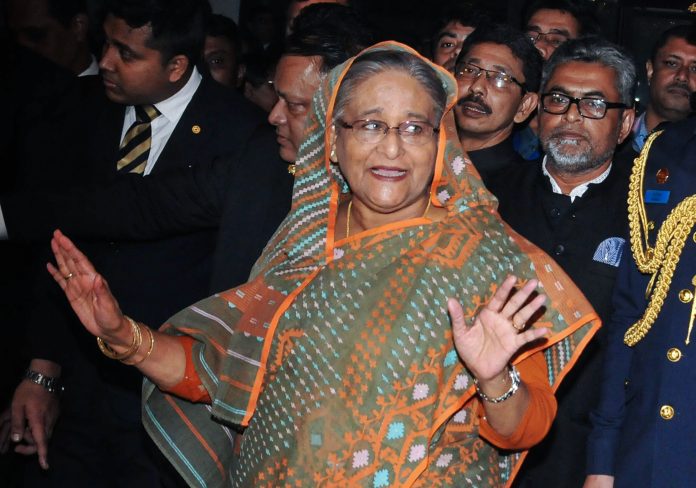
Sheikh Hasina, the ousted former Prime Minister of Bangladesh, stated she will only return to her homeland after the restoration of participatory democracy, lifting of the ban on the Awami League, and ensuring free, fair elections. In an exclusive interview with PTI from a location in India, Hasina expressed concerns over the Yunus-led interim administration’s impact on the country’s relations with India and accused it of fostering extremist forces.
Expressing her gratitude, Hasina said, “I am immensely grateful to India’s government and its people for their kind hospitality.” She emphasized that the primary condition for her return aligns with the desires of the Bangladeshi populace: a restored democratic system.
“The interim government must rescind the ban on the Awami League and allow inclusive elections,” she asserted. Hasina, who has served as Bangladesh’s longest-serving leader, left her country on August 5, 2024, following violent protests that led to her resignation.
Addressing whether her government mishandled the protests, the 78-year-old leader acknowledged, “Obviously, we lost control of the situation and that was regrettable.” However, she attributed the unrest to “seasoned political firebrands masquerading as student leaders” that escalated tensions.
Hasina dismissed allegations that she called for a boycott of the upcoming elections scheduled for February 2025. She maintained that an election held without the participation of the Awami League would be fundamentally illegitimate. “Tens of millions of people support us… It would be a huge missed opportunity for a country that badly needs a government with genuine consent of the people,” she remarked.
Continuing her critique of the Yunus administration, Hasina accused interim leader Dr. Muhammad Yunus of perpetuating “hostility towards India that weakens our strategic partnership.” She criticized him for relying on extremist groups and described his leadership style as chaotic and unelected.
Hasina assured Indian citizens unsettled by recent political developments in Bangladesh, “The interim government doesn’t represent what our people think. India is and will remain our nation’s most important friend.”
On the issue of accountability, Hasina expressed her willingness to be tried under international supervision, including at the ICC. She claimed that Yunus avoids such scrutiny because he is fearful an “impartial tribunal would acquit me.” She dismissed the Bangladesh International Crimes Tribunal as a politically motivated “kangaroo tribunal” designed to neutralize her and her party.
“They want to eliminate us as political forces,” she remarked. “The fact that they would use the death penalty to silence opponents shows how little respect they have for democracy or due process,” she added.
Furthermore, Hasina noted the initial support Yunus received from Western liberals has diminished. She asserted that this support is waning as they observe him appointing radicals into his cabinet, targeting minorities, and undermining the constitution.
The ongoing political tension in Bangladesh raises substantial questions about the future of democracy in the nation. As Hasina demands equitable political practices, how the interim government responds may significantly influence the landscape of Bangladeshi politics.
Overall, Sheikh Hasina’s staunch advocacy for democracy and accountability reflects a broader narrative concerning political integrity and international relations in South Asia.