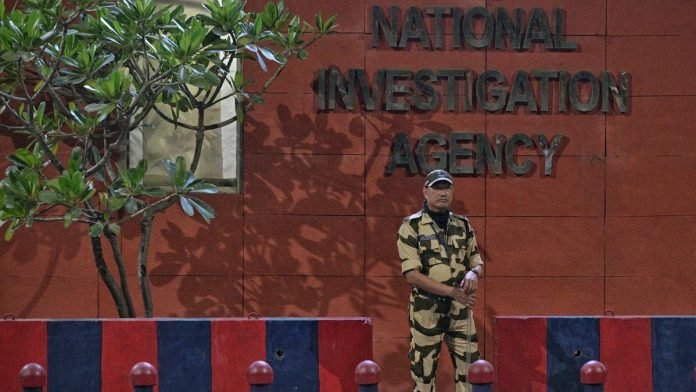
The National Investigation Agency (NIA) has taken significant action by arresting Jasir Bilal Wani, an alleged active co-conspirator of suicide bomber Umar un Nabi, linked to the tragic car blast near the Red Fort that claimed 13 lives. This arrest took place on Monday in Srinagar, Jammu and Kashmir.
Wani, a resident of Qazigund, faces serious allegations of providing technical support for terror operations. This includes modifying drones and attempting to fabricate rockets ahead of the November 10 explosion in the heart of Delhi. The NIA’s investigations prompt concerns about a sophisticated terrorist network operating both within Jammu and Kashmir and beyond.
Named also as Danish, Wani worked closely with Umar to orchestrate the fatal attack. The NIA is currently exploring various angles to uncover the conspiracy that led to the blast, deploying multiple teams to track down all individuals involved in this alarming plan. The agency is rigorously following leads across states to further dissect the extensive terror module.
With a background in political science, Wani revealed to interrogators that he underwent intensive radicalisation at the hands of Umar, who groomed him for months to become a suicide bomber. Their alarming association took root when Wani met Umar at a mosque in Kulgam last October, subsequently moving to a rented accommodation near Al Falah University in Faridabad, Haryana.
Initially positioned as an over-ground worker for the banned Jaish-e-Mohammed (JeM) network, Umar’s attempt to recruit Wani for a suicide mission fell apart due to Wani’s claims of economic distress and a personal conflict regarding the ethics of suicide in Islam. This twist sparked a precarious shift in the operation and revealed the extremist intent that lay behind the planned attack.
Investigators view Wani’s recruitment attempt as a troubling new layer in their investigation, which is now delving into a well-connected interstate terror network associated with JeM. Reports indicate that Umar, a 28-year-old from Pulwama, has risen as a dangerously radicalised figure, central to a network that stretches from Kashmir to Haryana and Uttar Pradesh.
Investigators believe Umar was gearing up for a potent VBIED (vehicle-borne improvised explosive device) attack, potentially scheduled to coincide with the anniversary of the Babri Masjid demolition on December 6. The objective was clear: plant an explosive device in a crowded area of Delhi or at a religious site before disappearing without a trace.
Wani’s earlier interrogations further revealed that his radicalisation accelerated following a trip to Turkiye in 2021, where he reportedly met several JeM operatives alongside co-accused Dr. Muzammil Ahmad Ganaie. Upon their return, both men, connected to Al Falah University, began purchasing large quantities of dangerous chemicals such as ammonium nitrate and potassium nitrate, storing them suspiciously close to campus.
The potential for devastation from their plans was thwarted when local police conducted an investigation leading to Ganaie’s arrest and the recovery of explosives. This crucial interruption may have sparked panic in Umar, culminating in the premature Red Fort blast.
The broader interstate terror network began to unravel back on October 19, when JeM posters inexplicably appeared in Bunpora and Nowgam near Srinagar. Local police responded swiftly, leading to the arrest of three individuals with histories of stone-pelting: Arif Nisar Dar (alias Sahil), Yasir-ul-Ashraf, and Maqsood Ahmad Dar (alias Shahid).
The questioning of these individuals facilitated the arrest of Maulvi Irfan Ahmad, a former paramedic-turned-Imam from Shopian, who allegedly played a pivotal role in radicalising the doctors within the terror network while supplying propaganda materials.
As the NIA continues its extensive investigation, the implications of Wani’s arrest could echo throughout the region, shedding light on a network determined to exploit deep-seated grievances and manipulate youth for extremist agendas. The agency’s efforts are crucial to dismantling the JeM’s operations and preventing future attacks.