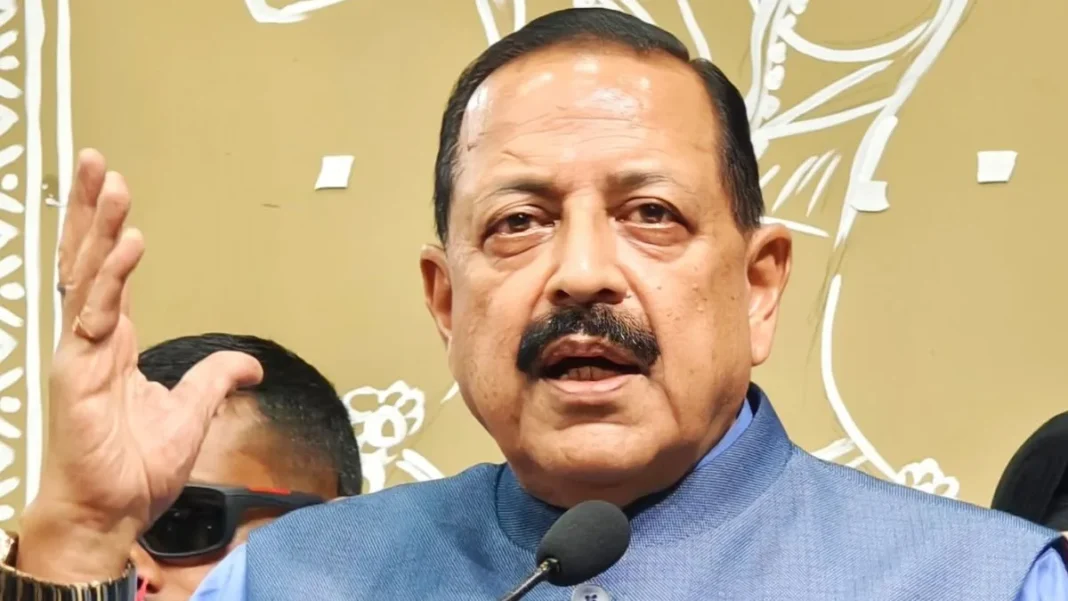

Union Minister of State (Independent Charge) for Science and Technology, Dr. Jitendra Singh, proclaimed Jammu and Kashmir’s pivotal role as the torchbearer of India’s ambitious journey towards ‘Destination 2047’. Speaking at the launch of the ATL Sarthi and Frontier Region Programme of the Atal Innovation Mission (AIM) at the University of Kashmir, he emphasized the vital contributions the region can make as India’s economy evolves.
Dr. Singh noted that as India’s economy ascends from rank four to three, the boost will stem from previously overlooked regions like Jammu and Kashmir. He acknowledged that it is only under Prime Minister Narendra Modi’s leadership since 2014 that J&K has begun to receive the attention it deserves. The Union Minister stressed the region’s untapped resources, including the Himalayas and rivers, have become accessible through initiatives like the Aroma Mission.
Underlining the transformative potential of J&K, Dr. Singh expressed optimism that the union territory could emerge as a crucial contributor to India’s innovation-led growth story over the next two decades.
Congratulating Kashmir University for its significant role in integrating J&K into the nation’s growth narrative, he described the launch of ATL Sarthi as a ‘dual celebration’. This initiative represents both Kashmir University’s commitment to fostering innovation and AIM’s expansion of its network into this peripheral Union Territory.
In his address, the Minister announced ambitious plans to set up 500 new Atal Tinkering Labs (ATLs) in J&K, which forms the largest share of 2,500 sanctioned labs aimed at fringe regions. With an investment of ₹100 crore, these labs will introduce school students to advanced tools in robotics, 3D printing, and artificial intelligence, encouraging early innovation.
Dr. Singh pointed to the significant growth in India’s economy driven by technology sectors such as space, biotechnology, and oceans. He mentioned that India’s space economy, which grew from virtually nothing to $8 billion, is expected to reach $40–45 billion within the next decade, fueled by over 400 active startups.
Highlighting the significance of public-private partnerships, he stated, “Unless we devise a method of involving private players, we cannot sustain growth.” Citing successful collaborations like InSpace in space research and BIRAC in biotechnology, he demonstrated the necessity of structured partnerships for sustained success.
Focusing on J&K’s blossoming sectors, the Minister drew attention to the ‘Aroma Mission’ and floriculture, which have led to the establishment of numerous startups in lavender and flower cultivation. He shared that approximately 3,500 lavender startups currently thrive in the region, with young entrepreneurs returning from corporate roles to engage in these promising ventures that extend beyond traditional government jobs.
On the innovation front, Dr. Singh highlighted the impressive performance of local students, noting that 50 from J&K ranked among the top 1,000 nationwide in the School Innovation Marathon. He encouraged students and parents to discard the myth that successful startups are confined to metropolitan areas, emphasizing that nearly half of India’s startups originate from Tier 2 and Tier 3 cities.
“As we envision India@2047, the students in these tinkering labs will be in their prime working years. They will serve as the torchbearers for a developed India. Through them, J&K will shine as a leading player in this national journey,” he concluded.
The launch event also saw attendance from Lieutenant Governor Manoj Sinha, Chief Minister Omar Abdullah, Education Minister Sakina Masood, University Vice-Chancellor Prof. Nilofer Khan, and AIM Mission Director Dr. Deepak Bagla, underscoring the broad support for this innovative initiative.