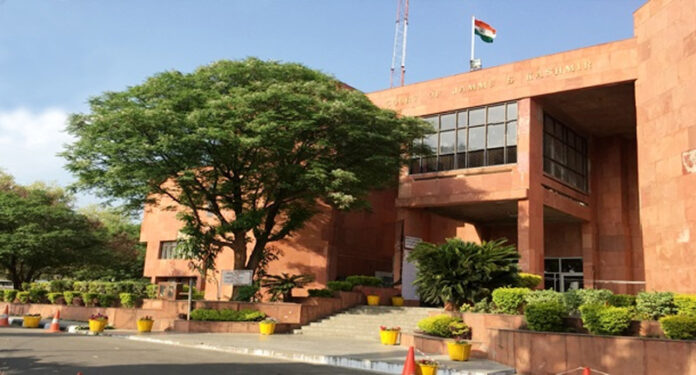

The High Court of Jammu & Kashmir and Ladakh has upheld the order of the Revisional Authority directing continuation of land partition proceedings in accordance with applicable rules, while vacating an interim status quo that had stalled the process for several years.
The judgment was delivered by Justice Wasim Sadiq Nargal in a petition filed by Sikander Sharma challenging the January 6, 2021 order passed by the Additional Commissioner, Jammu, acting as Revisional Authority. The petitioner had questioned the legality of the remand order directing the subordinate authority to proceed afresh with the partition proceedings after granting due opportunity of hearing to all stakeholders.
The High Court observed that the Revisional Authority’s order had been passed with the consent of counsel representing all parties. It held that advocates act as authorised agents of their clients and once consent is recorded in judicial proceedings, parties are ordinarily estopped from challenging the order later unless there is clear evidence of fraud, coercion, or patent lack of jurisdiction.
Emphasising the binding nature of consent-based orders, the Court stated that such directions are intended to bring finality to disputes and prevent prolonged litigation. It ruled that the petitioner could not withdraw from a position earlier accepted through counsel merely because the outcome subsequently appeared unfavourable.
Rejecting the contention that the remand was contrary to law, the Court clarified that the impugned order did not conclusively determine rights but only required the competent authority to re-examine the matter under the relevant Partition Rules after hearing all concerned parties. It noted that such a procedural direction caused no prejudice and instead ensured fairness in adjudication.
The Court also vacated the interim status quo order dated February 1, 2021, observing that its continuation was not conducive to justice as it effectively prevented the revenue authorities from acting on the Revisional Authority’s directions.
Relying on Supreme Court precedents, the High Court reiterated that consent decrees and compromise-based decisions create an estoppel and are meant to prevent endless litigation cycles. Finding no illegality or jurisdictional error, the Court upheld the January 6, 2021 order and directed the competent authority to conclude partition proceedings strictly in accordance with law after granting opportunity of hearing to all interested parties and passing a reasoned order.
Advocate R.K.S. Thakur appeared for the petitioner, while Advocate Priyanka Bhat, vice Senior AAG Monika Kohli, and Advocate Ajay Abrol represented the respondents.