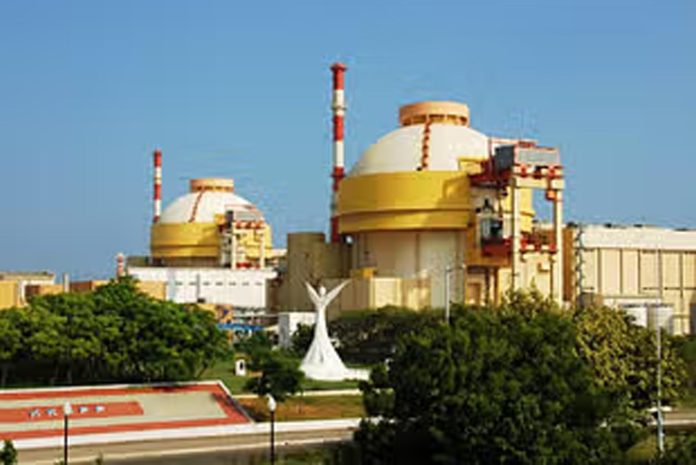

India’s ambitious three-stage nuclear energy programme is set to reach a key milestone as the country’s first Prototype Fast Breeder Reactor (PFBR), under construction at Kalpakkam in Tamil Nadu, is expected to be commissioned by 2026, officials from the Department of Atomic Energy have confirmed.
The 500 MW PFBR, developed by Bharatiya Nabhikiya Vidyut Nigam Limited (BHAVINI), has entered the advanced stage of integrated commissioning. The reactor is likely to achieve its first criticality—a crucial step in nuclear activation—by 2025-26.
This development marks the second stage of India’s nuclear roadmap, which envisions an energy-secure future through the recycling of spent nuclear fuel. The PFBR is unique—it uses plutonium-based mixed oxide fuel and liquid sodium as a coolant. It is also designed to utilise the spent fuel from Pressurised Heavy Water Reactors (PHWRs), which currently form the backbone of India’s nuclear infrastructure.
While the country’s operating nuclear plants fall under the purview of the Nuclear Power Corporation of India Limited (NPCIL), BHAVINI is solely responsible for developing fast breeder technology in India.
Last year, Prime Minister Narendra Modi witnessed the commencement of core loading at the PFBR. In July 2023, the Atomic Energy Regulatory Board (AERB) granted clearance for fuel loading, initial criticality operations, and low-power physics experiments at the reactor site.
Fast Breeder Reactors (FBRs) are a critical component of India’s long-term nuclear vision. They will eventually feed into the third stage of the programme, which involves thorium-based reactors, exploiting India’s vast thorium reserves to generate sustainable and clean energy.
India’s Expanding Nuclear Ambitions
India currently has an installed nuclear power capacity of 8.18 GW. Projects totaling 7.30 GW are under active construction or in the commissioning phase, while another 7.00 GW has been sanctioned and is undergoing pre-project activities. The government aims to scale up this capacity to 22.48 GW by 2031-32.
Looking further ahead, NPCIL has laid out plans to add:
- 15.40 GW through indigenous PHWRs
- 17.60 GW through Light Water Reactors (LWRs) in collaboration with foreign partners
- 3.80 GW via BHAVINI’s Fast Breeder Reactors
- Additional capacity through Small Modular Reactors (SMRs) and Bharat Small Reactors, to be developed with private sector participation
As part of its nuclear energy mission, the Indian government has set a target of 100 GW electricity generation from nuclear sources in the coming decades, positioning the country as a global leader in advanced nuclear technologies.